Showing posts with label Some Thoughts About Past and Present. Show all posts

15 July 2019

Discourses on Salt and Iron - Part 2, Chapters 55 and 56

I'll probably talk about the inaccuracies behind labels like Confucianism, Daoism, and Legalism in part 3.
This is part two of my post on the Discourses on Salt and Iron, which I'm planning on making into a 3-parter. The two chapters I've translated here mostly debate the true purpose and meaning of law and how to actually promote an orderly society. It's a little redundant in the sense that each side essentially makes the same point over and over again, but it's pretty funny how each time, they try to turn around the analogy or expression their opponent just used against them. Also, there's nothing quite like reading expressions in different languages that are purely the product of differing cultural references.

The upcoming third and final part won't have any translations but will be just my thoughts on the rhetoric and historical background regarding the debate points I've translated. For the translation, I'd say I tried to be 80% literal so I could preserve a lot of the colourful expressions, parallelisms, and syntax. The quotations from the Book of Odes are from James Legges' translation but everything else is my translation which means that there may/will be some errors since I'm no expert in classical Chinese.

11 May 2019

Discourses on Salt and Iron - Part 1, Chapter 34: De-prioritizing Punishments

These are pictures of a Ming-era percussive deep well drill used to extract brine. On the right, you can see bamboo tubes that feed natural gases to the stoves where the brine is evaporated for salt. What's particularly surprising that the two essential aspects of the brining operation, percussive drilling rigs and gas stoves, as seen above were all developed by the time of the Han dynasty (206BC-220AD), and later centuries simply improved on the process to construct better rigs that could dig deeper and deeper. For a better idea of how this all worked, you can take a look at this page and watch the video below:
 
I bring this up to point to the sophistication of the salt industry in Han China, which monopolized it along with the iron industry to fund its vigorous foreign policy, primarily against the Xiongnu steppe nomads to the North. Although a topic of great interest for historians of science and industry today, the salt and iron monopolies was a pivotal issue in imperial China that for thousands of years, shaped the ideas of emperors, scholars, and officials on what the ideal role of a state should be, what the ideal type of governance should be, and what the ideal relationship between a state and its economy should be. This was possible because the famous debate between those who advocated the monopolies and those who decried it were immortalized by the government official Huan Kuan in Discourses on Salt and Iron (Yan Tie Lun 鹽鐵論). A somewhat rough analogy for the American would be the influence that the Federalist papers have had on American thought on the nature of their republic. It is a rough analogy, of course, because whereas the Discourses on Salt and Iron gives equal weight to both sides to show how the dialectic between Legalist and Confucian thought played out in shaping government policy, the anti-Federalist papers had been, I think, much less read and influential.

22 August 2018

Some Thoughts on the Roman Republic's Weakneses

It's been close to a year since I last wrote on a topic from European history, so with my 5-part post on Classical Chinese done, I think now's a good time. And since I just began translating Ad Astra, I'll go mainstream and talk about Rome for once. But rather than talk about how strong Rome was thanks to its military, I'm going to talk about how weak the Roman Republic was as a state and how this contributed to its fall. Just a heads-up, this post is really just a book summary in disguise which — I know, I know — is a lazy thing to do. But I do think the book brings a perspective many supposed Romaboos who only ever read Osprey military books don't quite seem to be aware of.

20 July 2018

Some Thoughts on Diplomacy and War (An Exercise in Literary Chinese - Part 5)

At the end of part 4, we finally managed to cover the Zhanguo Ce chapter in which Yan Lu's diplomatic finesse managed to save Zhou from a Qin invasion and protect the nine-ding. I assume for many people, their first reaction to this story might be a minor nod of interest and then to move on. However, I think there's a bit more to mine from this story on the relationship of diplomacy and war. Or at least, I'm going to over-analyze it so I can fill out this post. So for the conclusion of my 5-part series on literary Chinese, I'll make an argument that to conceive of diplomacy and war as mutually exclusive alternatives to each other is to limit the effectiveness of both.

18 June 2018

An Exercise in Literary Chinese - Part 4

Alright, I was initially planning to end this series with the 4th part, but it looks like it'll be a 5-parter. For this part, I'll quickly wrap up translating the remainder of the story. By now, I've covered most of the main grammatical rules we need to know so I'll be covering the sentences much more quickly.

The concluding part 5 coming later this week should be much more interesting as I turn away from the grammar-lessons and comment on the intersection of diplomacy and war in history in order to appreciate this story.

*For any nerds interested in learning more about literary Chinese, or are planning to major in that area, there are a lot of readily available resources to be found on the internet. You can very easily find pdfs or ppts put up by university professors as part of their classes on google. I will upload a zip file containing 5 helpful textbooks that I'm slowly working through myself.

Download:
Literary Chinese text/workbooks:   Mega

12 June 2018

An Exercise in Literary Chinese - Part 3

Open this in a new tab to look at it while reading this post.
Now that we've covered most of the background, in part 3, we'll focus mostly on translating the next 9 sentences.

Be sure to read Part 1 and Part 2 before this.

7 June 2018

An Exercise in Literary Chinese - Part 1

Zhanguo Ce (Strategies of the Warring States), chapter 1.
It looks intimidating, but trust me, it's not so bad.
Instead of talking about manga, current events, or books I've read, I'm going to do something very different in these posts. You see, I once listened to a particularly inspiring presentation in which the lecturer did a combined history lecture/primary source analysis/language lesson on a passage from Shiji to an audience that largely knew neither Mandarin nor literary Chinese. So today, I'll attempt my own version of this. I'm going to assume you know little to nothing about Mandarin, literary Chinese, nor ancient China in general. And I'm going to decode that wall-of-text you see in the image above, line by line, while giving necessary background info and interesting historical tidbits. I've only actually started self-studying literary Chinese myself with no Mandarin background so I know I'm not the best teacher. Still, I hope this will be a fun post for anyone curious about ancient China or who ever wondered what kind of language literary Chinese is.

This will be a multi-parter, since it's too damn long to fit in one post.


2 May 2018

Some Thoughts about Adults in the Room

The year is not even half-done, but I'm quite confident that Yanis Varoufakis political memoir, Adults in the Room: My Battle with Europe's Deep Establishment, will be one of my top-3 reads for 2018. Now I've been aware of Varoufakis since 2015 when Greece's bailout referendum was all over the news. So I was already aware of common arguments Varoufakis and other economists cited on why austerity was bad economic policy, or why the EU was making a colossal mistake in its handling of the Greek debt crisis. But to vicariously experience that fateful 2015 through the eyes of an insider as Varoufakis is something else entirely. So whether or not you're familiar with the Greek debt-crisis, I highly, highly recommend reading this book. Sure, given that it's a political memoir written by a "loser," it's hard to tell just how objective and truthful of a writer Varoufakis is, but if even only half of the things he tells in this book are true, it still makes for a shocking read. Like my other Some Thoughts posts, I don't mean to do a proper review or a convenient summary. Instead, I'll ruminate on some tangential ideas I had while reading this book.

21 April 2018

Some Thoughts About Empires and Emperors

Empire (noun): Government-rank requiring at least 1000 development
What does an empire and pornography have in common? They're both hard to define, yet we all think we know one when we see one. Games such as EU4 and CK2 offer extremely simplified definitions that an empire must be ruled by an emperor, and it must be at least thiiiis big, which draw from a conventional idea that an empire should mean "a sovereign government ruling over multiple political societies." But then you have the academics come and scoff at the imprecision of such a definition. For instance, where do we draw the line at distinguishing significant "political societies?" Does a single city that has its own political identity and community count? And what does "ruling over" mean? Does it refer to only 100% control or is it compatible with large local autonomy? If state A exercises economic but not political control over state B, is B a part of A's empire? If state A gives freedom to state B on running domestic affairs, but partially limits its decision-making in foreign affairs, is B a part of A's empire?

Meanwhile, in more sophisticated academic definitions of empire, the empire is defined simply to aid in categorization for modern-day scholars rather than taking into account how peoples in the past have historically understood the term. So I thought it would be fun to point out ways in which both "empires" and "emperors" have been understood historically in Europe and East Asia that might run counter to common definitions today. It's not a topic that gets a lot of attention in popular history, so hopefully I'll cover stuff you hadn't considered before.

26 February 2018

Some Thoughts on a Decade as a Scanlator

Let's see if I can go another 10 years before YHWH give me arthritis or some shit.
I wasn't planning on this post, but a 10 year-anniversary literally doesn't come every year, so allow me to ramble a bit today about my thoughts on the past 10 years as a scanlator.

31 January 2018

Past and Present - 02/2018 (last updated Feb. 1)

You may not like it but this is what peak best-girl looks like.
Like with my scanlation activity, Past and Present was shoved way back into my list of priorities, but here I go again. To be honest, at the moment, I'm reading more academic papers than I am following current events so don't expect me to comment on a lot of the big news stories.

Once again, just a warning about possible uneducated/unqualified opinions. Don't take me as some super trustworthy commentator, because I'm not.

21 January 2018

Some Thoughts on Creating Modernity from Antiquity

"Ancient Wisdom." It's a term that really only gets taken seriously in areas related to new age medicine, spiritual health, diets, or other hippie-ish shit that I disdain. But from a wider historical perspective, it is a bit sad to see how little we care for ancient wisdom or antiquity in general. That's not to say I'm some luddite or nostalgiafag, but I am fascinated by how much "Antiquity" occupied the minds of past peoples. There was once a time — a time long before it was considered normal to buy a new smartphone after just paying off your last phone's payment plans — when "Antiquity" meant legitimacy, truth, and wisdom. I write antiquity here as "Antiquity" because in an age before sophisticated archaeological and historiographical analyses, popular conceptions of antiquity were more imagined than real. Such imagined constructions of "Antiquity" allowed for new interpretations and ideas, while called a revival at the time, would actually inch society closer to modernity. And it's on this point I just wanted to share some fun examples today.

15 October 2017

Some Thoughts on Hyougemono and Kōraimono

"A month and a half and still no manga release, Hox?" Sorry, I swear I'm busy so the drought will continue probably for the remainder of this month. In the meantime, I offer this post on manga and history (though it's more about history) as an appeasement. The topic today will be about Kōraimono (高麗物) in Hyougemono.

1 October 2017

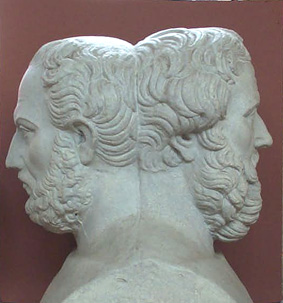
Some Thoughts on Herodotus and Thucydides

Sigh. September has come and gone and I only made one manga release. I've been too busy to even keep up with the news and make a current events post, which is a real pity because the whole Kurdistan issue really does demand attention. Maybe this post to start off October will make me feel that I haven't been neglecting this blog too much. I honestly wasn't expecting to write this, but I just had an amusing thought the other day when I was re-reading parts of Herodotus' The Histories, so I thought I should write it down before I forget it.

3 September 2017

Some Thoughts About Modernity

I'll have what he's having.
If academics love anything, it's to squabble over definition of terms, whether it's because it's too general, teleological, materialist, theoretical, anthropocentric, or just plain "problematic." Even something like the term "species" which the average person learns in middle school how to define turns out to be hella difficult to define. And among these wars of definition, modernity stands out as one of the most nebulous terms. As each discipline has its own internal debate on whatever the hell it really means, trying to find a consensus definition a little more precise than "something not ancient" (and let's define ancient as something not modern!) seems futile. I personally don't care too much about these debates; rather than being real issues, they seem more like problems we inadvertently created for ourselves because our brains desire specific ways of subjective categorization which the universe just laughs at and refuses to play along. That being said, I couldn't help but think about one way to look at modernity when I recently read Seeing Like a State. So in this post, which isn't meant to be a review of the book in any way, I'll touch upon the book's idea of high modernism as I ponder about modernity in general.

5 August 2017

Past and Present - 08/2017 (last updated Aug. 5)

Ughh, July was a real pain for me but it's finally over, meaning more free time at last! Hopefully I can finally do that post on Seeing Like a State like I wanted to 2 months ago but first, some current events stuff.

Translation of Wombs will be resuming btw, for those of you wondering what the fuck was going on.

7 June 2017

Past and Present - 06/2017 (last updated June 15)

Been super busy the past two weeks, and as luck would have it, that also coincided with a whole bunch of shit going down in the world. So my June's edition of Past and Present is mainly me trying to catch up on all the big stuff. I'll post history papers next week. History papers now added.

P.S. Thanks to the guy who recommended me James Scott's Seeing Like a State. I wanna write some sort of loosely-related essay, but give me some time.

1 May 2017

Past and Present - 05/2017

I felt like I haven't read enough papers as of late, so I'll start the May edition of Past and Present by posting a whole slew of papers. Hopefully, at least one or two of these will be of interest to people.

28 April 2017

Shiji v2: Revenge-Seekers (complete)

Some closing comments on this volume which dealt with two famous revenge-stories in the Spring and Autumn period. Goujian's story is worth remembering for playing a huge role in Chiang Kai-Shek's Nationalist (Kuomintang) party's rhetoric/propaganda. The humiliation that Goujian endured to eventually enact his revenge deeply resonated among Chinese in light of Japan's aggressive foreign policy during the early 20th century and the Woxin Changdan (臥薪嚐膽) idiom was frequently used as a nationalist slogan. Chiang Kai-Shek, born in Zhejiang which was the same place that Yue was situated, similarly saw the connections between Goujian and himself. He ordered the compilation of Goujian's biography in two versions (one in literary, the other as colloquial) and his personal diaries note how he used Goujian's story to convince himself not to respond to Japanese provocations even in the face of harsh vocal opposition. After defeat in the Civil War to the communists, Chiang and the Nationalists still holding out in Taiwan once again evoked Goujian's story to nurture hope. For more detailed information, I recommend reading History and Popular Memory: The Power of Story in Moments of Crisis.
Meanwhile in Japan, Woxin Changdan (pronounced as Gashin Shoutan in Japanese) was famously evoked regarding the Triple Intervention to settle the First Sino-Japanese War. Japan saw the foreign diplomatic intervention as an under-handed Russian scheme which robbed Japan of greater gains from the war. As Japan was in no shape to confront a Russia backed by France and Germany at the time, it endured the humiliating conditions only to later have its revenge in the Russo-Japanese War.

Now regarding Wu Zixu, the Shiji chapter on his life is notable for concluding with a commentary from Sima Qian:
The poison of resentment in man is extreme indeed! A king cannot provoke it in a minister, much less in a peer! If previously Wu Zixu had been made to follow Wu She in death, how would he differ from an ant? But he rejected a small principle to wipe away a great shame, and his name is passed on to later generations. Now, whether hard-pressed on the Yangtze River or begging food along the road, how could his mind, even for a moment, forget Ying? Therefore, he silently endured and obtained merit and fame. If not a man of virtue, how could he have reached to this?
If you recall the very first chapter of this manga which covered Sima Qian's life, you'll remember that Sima Qian also chose to endure shame by being castrated in order to complete his father's dream of writing the Shiji. It's clear that Sima Qian saw himself in the story of Wu Zixu, but as historian Stephen W. Durrant notes in The Cloudy Mirror, their methods of revenge are different in style. Wu Zixu violated ethical norms by whipping a corpse while Sima Qian simply slaved away in the imperial archives and wrote a book. So if Sima Qian concludes that Wu Zixu "silently endured and obtained merit," then it's more likely a case of Sima Qian becoming carried away by his own biases and describing his own situation instead of Wu Zixu's life.

Hope you enjoyed the short history lesson. I'll do volume 3 in late summer/early fall.

Download:
Shiji v02:   Mega
Shiji v02 c01:   Mega
Shiji v02 c02:   Mega
Shiji v02 c04:   Mega
Previous volumes: Mega

1 April 2017

Past and Present - 04/2017 (last updated Apr. 20)

Been pretty tired and busy lately, which explains why I didn't update much during March. I'll try to do better this month. Also for Soil fans, don't worry, more releases will be coming soon. My editor for that was also tied up last month. And I'll get started on 2nd volume of Shiji this month too.