If you want to get dl links for this month's Vinland Saga and Historie, go to Happy-Scans site (happyscans.blogspot.com). They should have both done and uploaded sometime later today if all goes well. Gonna be without internet for the next several days, thus this post.
In case the absence of releases this past week hasn't tipped you off, I'm heading towards hibernation-mode for the next month (possibly 2 months) due to real life. So here's the basic project status for the curious.
Goodnight Punpun: Asano said on his twitter that v11 is expected to be out at the end of November.
Gyanki-Hen: Wait another 3 months. So probably this Nov/Dec.
Sangokushi: Will resume after my break is over.
Tomorrow's Joe: Will resume after my break is over.
Alabaster: Real sorry that I'm slowpoking on this. I promise both volumes will be out by at least spring '13.
Monthlies (Vinland and Historie): Will still do but the releases might come 2-3 days later than I would normally have it out by.
With that out of the way, it's time for another section of Some Thoughts About Good Manga. First one up is Aoi Honoo by Shimamoto Kazuhiko. He's probably best known in modern times for the Anime Tenchou mascot he created for Animate (which had a promotional video directed by Imaishi), but back in the 80s/90s, he was noted for other works such as Blazing Transfer Student, Gyakkou Nine, and Burning Pen. Speaking of Blazing Transfer Student, there was a 2-episode OVA of it made by Gainax, but for some reason, they seem to have forgotten/disowned it and don't even have it listed as one of their works on their official website (what the hell, Gainax). If anybody knows the reason for this, please do tell. But I'm getting side-tracked here, so back to Shimamoto. Well actually, I don't really need to talk any more about him because Aoi Honoo is a loose autobiography of his life.
(The white bars on this inside cover page are comments from Adachi Mitsuru and Takahashi Rumiko)
The basic plot is that Shimamoto Kazuhiko Honoo Moyuru is a first year student enrolled in Osaka (大阪) Osakka (大作家) University of Arts who dreams of making it in the anime/manga world. Unfortunately, his skills can't quite keep up with his ambitions, making his journey a bumpy one. Now maybe you've read other autobiographical manga such as Disappearance Diary or A Drifting Life and didn't like them very much (unlike me) so you want to know why you should be any more excited over this one. To that, I can confidently say this: If you consider yourself to be an anime/manga otaku, you have a very good chance of enjoying Aoi Honoo. The reason is that Shimamoto, unlike Azuma or Tatsumi, tells his story from the perspective of a die-hard otaku.
A die-hard otaku primarily influenced by the holy trinity of Ishinomori Shoutarou, Nagai Go, and Matsumoto Leiji, Shimamoto/Honoo gives a window for us young'uns to see what life was like for an otaku at the dawn of the 80s, a decade which would bring many changes for the anime/manga industry. It was a time in which Takahashi Rumiko and Adachi Mitsuru were starting to become the new faces of Shounen manga, while the likes of Ootomo Katsuhiro and Takano Fumiko would distort the traditional boundaries that separated shounen, shoujo, and gekiga manga in a movement later termed the New Wave. A time in which a group of college nobodies would take the otaku world by storm with the animated shorts Daicon III & IV and later go on to found Gainax. A time in which Betamax, VHS, Walkmans, and even Pocari Sweat were starting to sweep over Japan. These are all events witnessed first-hand by Shimamoto and covered in Aoi Honoo.
Honoo marvelling at the joys of Kanada-esque animation
Shimamoto's usual hot-blooded enthusiasm and passion are absolutely contagious for fellow anime/manga fans and arguably the best scenes come from him (over)analyzing his hobbies, whether it be Doraemon's new opening, the implications of long and short-hair on the heroines of Adachi Mitsuru's manga, or his doubts on Ootomo's future due to his art's realism and detail.
Gendou wishes he could be this badass.
The next best scenes are any time Honno's eccentric classmate and character foil, Anno Hideaki appears (yes, the Anno). Whereas Honno is a loud-mouthed, marginally talented but self-deluded youth aspiring to become a mangaka, Anno is a genuinely gifted aspiring animator who lets his work (see video below) do the talking.
As the 2nd protagonist of Aoi Honoo, the story periodically switches from Honno to Anno in order to tell the behind-the-scenes story on how Daicon III & IV were made by a group of college students barely in their 20s. So if you're interested at all in Gainax's beginnings, you ought to give Aoi Honoo a chance (but if you can't read Japanese, there's always the book Notenki Memoirs).
Yamaga Hiroyuki
Having said all this praise, there is one problem I have with Aoi Honoo. Though I'm not yet caught up with the latest volume (currently ongoing in Japan at 8 volumes), when looking back, I feel that the story hasn't progressed quite as much as I'd expect it to after 6 whole volumes. There's been quite a few unnecessary chapters covering stories that're hardly related to Honoo's actual quest to becoming a pro-mangaka. Some are understandable based on the fact that Shimamoto's trying to paint a better picture of life in the 80s but others just seem...pointlessly meandering. Then again, there's no such thing as a tight, focused plot in the thing called life, and perhaps I'm unfairly carping on elements inherent to autobiographies. Overall, it's a highly entertaining read and I really do hope some translator will step up and pick it up (my hands are a little tied at the current moment).
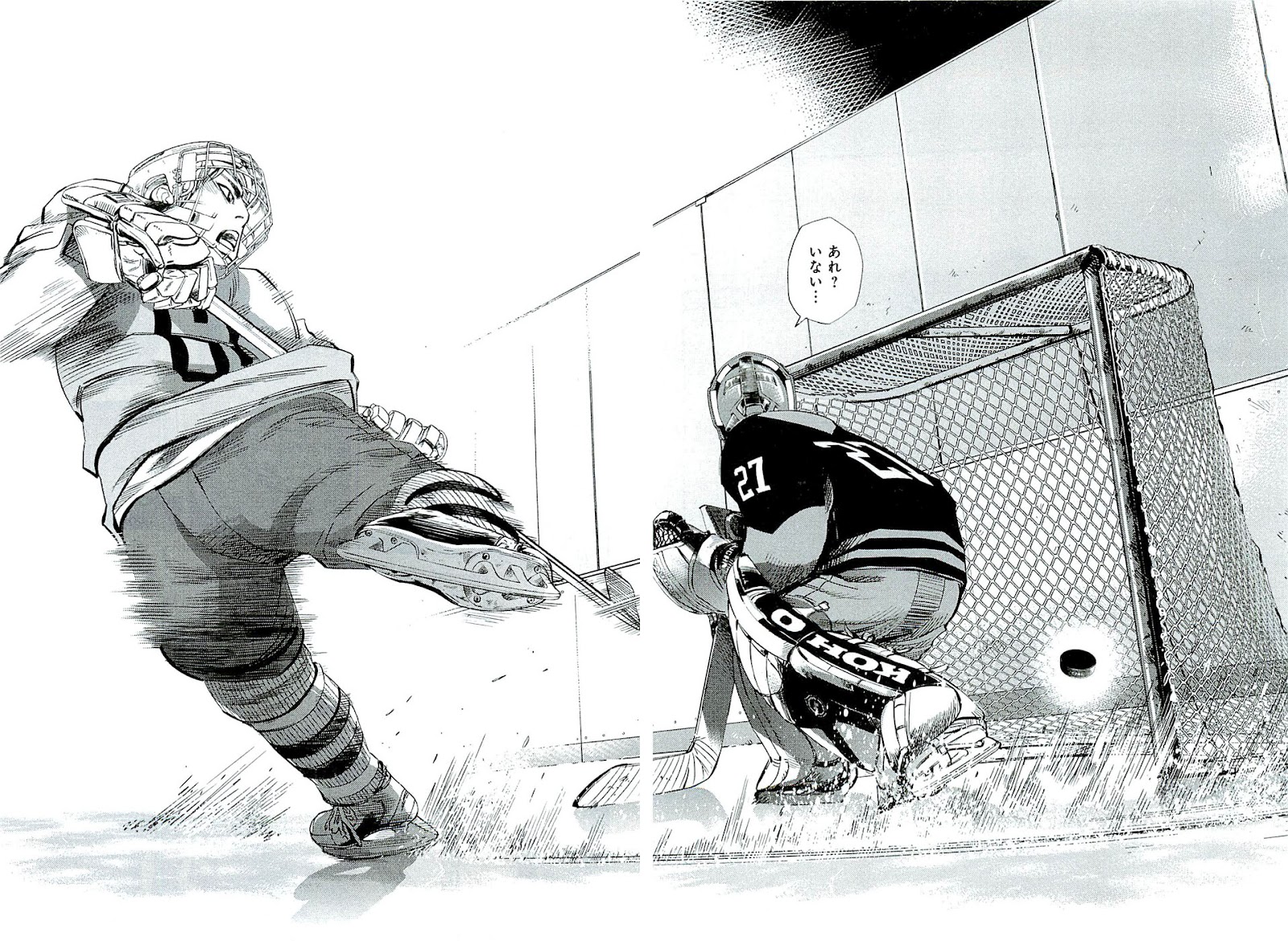
The other manga I want to talk about is Spinamarada! (the title comes from the mispronunciation of Spin-o-rama) because HOLY SHIT, IT'S A MANGA ABOUT ICE HOCKEY. Now Japan and hockey aren't exactly a "winning combination" (above vid related) but surprisingly enough, there actually have been several other ice hockey related manga in the past, as listed by the Japanese wikipedia page on ice hockey. But a lot of them, like Kumeta's Go!! Southern Ice Hockey Club, have rather mediocre artwork when it comes to the actual depiction of the sport, so it's hard to get excited as a hockey fan. But along comes this manga with a cover page like this:
Finally, a sports manga where I actually like the sport being played.
Realistic equipment, brands, and serious-looking art? Damn, sign me up. It might seem like a trivial reason to pick up a manga for, but ice hockey's just one of those sports that's hard to find any good depictions in media, much less serious ones. Hollywood, for one, gets carried away with the fact that physical contact is allowed and ends up showing nothing but over-the-top goon hockey comedies (thank god for movies like The Rocket though). In any case, as soon as I heard about this manga, I immediately grabbed the raws and dove right in, giddy with expectations. After reading all 4 volumes currently out, I came out, well... both disappointed and entertained.
The premise is as follows: Shirakawa Rou (age 15) is a figure skater who carries the hopes of his divorced mother, an ex-olympic figure skater, to become an olympic medallist. But following his mother's death in a car-crash, he gives up on figure skating and moves to his grandfather's home in the city of Tomakomai, Hokkaido. There, he discovers another world on ice yet unknown to him called ice hockey.
Spinamarada is actually the first full-length serialization for the rookie mangaka Noda Satoru (unfortunately I couldn't find any pictures of him on the internet). As expected for a rookie (and to my slight disappointment), Noda plays his story safe, sticking with most of the standard conventions of shounen sports manga.
Tough-as-nails coach? Check.
INTENSE, special training? Check.
Hot-headed and cool-headed athlete archetypes? Check.
Token black guy who's in Japan for some reason? Check.
Yelling out the names for players' special moves? Thankfully, no. The story might have its cliches, but it's not that goofy.
So yeah, there's nothing too surprising from the story, but at the same time, the safe, conventional approach keeps the story at a moderately entertaining level. The bigger problem I have with Spinamarada is the art.
One, the character design. When it comes to anime/manga, the characters are what the audiences will usually take notice first so if you're an artist, you better make a lasting impression. I think it's obvious to anyone that most artists for anime/manga use distinctive hair style/colour, and visual markers like ahoge as a poor crutch for their lack of skill to draw actually distinct faces. The main problem with this crutch is that you're fucked when you try to apply it to ice hockey manga because guess what? Your precious hair is covered up by the helmet. Murata Yuusuke also had to tackle this problem in his manga Eyeshield 21 , in which I'd say he somewhat succeeded, though he had a considerably easier time since he could simply have his characters take off their helmets whenever the play stopped. Which he did. Constantly. Noda Satoru doesn't have the same option, however, since hockey players will only rarely take off their helmets during a game/practice. So unfortunately for him, his technical skills haven't yet developed enough to make each player distinctive from one another as the above picture shows. Sure, there are differences in the general eye and nose shapes, but they're still insignificant on the whole and he has a long ways to go. By the way, if you want to see an example of good character design in manga, go check out Katou Shinkichi's works. Now that's a mangaka who can draw either simplistically or detail-heavy to draw distinctive faces, both of which honestly acknowledge their medium and revel in its ability for expressiveness instead of dishonestly watering it down for the sake of "photographic realism."
Two, those goddamn white shadows. It absolutely drives me nuts when I see mangaka put white shadows around their characters to help them stand out better from the background. Why? It makes the characters look like they're shitty paper-cutouts that've been glued onto the background, which makes them look horribly flat and ruins the sense of perspective in the drawing. Am I alone in this or does this bother any of you guys as well? This is something I've never actually discussed with anybody else so I'm quite curious to see whether I have a legitimate point here or just sperging out.
Three, the depiction of the game. For a static medium like manga, you can imagine the challenges that would come with depicting a fast-paced team sport. The important thing is to show key scenes that establish the general flow of the game. Showing the breakaways, the big hits, and frantic saves are nice and all, but highlight-reel material alone is usually never an accurate portrayal of the game as a whole. So far in the first 4 volumes, there've been 3 games shown and I don't particularly feel that the mangaka has successfully managed to depict this flow or a general idea of each team's play styles. Then again, I might be being overly critical since one of the games was intentionally kept short, while the other two games serve as introductory games for the protagonist and Japanese reader still new to hockey. If that's the case, hopefully as the story proceeds, it'll introduce those elements gradually.
The last issue I want to mention is very, very, very minor, and not really a point of annoyance as it is a point of confusion. Noda Satoru seems to have an odd aversion to the Bauer brand by spelling it as Baner. Brand name changing is pretty standard stuff (ex. WcDonalds in anime) but it strikes me as bizarre when other brands like CCM, Easton, Sherwood, and Koho are unchanged in the manga. What's even stranger is that in some panels, you can see players with Bauer skates. So why change the logo for only the helmets? Maybe an inside joke between the mangaka and his friends? Who knows.
By now, you might be wondering why I even bothered to post about this manga for the Some Thoughts About Good Manga section with all these complaints I'm bringing up. Well... One, the story and characters might not be pushing any boundaries but they're still comfortable in a good way. Two, it's got some nice comedic moments here and there. Three, it's pretty much the best hockey manga there is as far as I know. That might not be saying much, but if you're a hockey fan, it's plenty enough reason to read it.
Oh, by the way, did I mention the MC's love interest has thighs that would make Araki's Pillar Men proud? That's gotta count for something.
Chapter 41-43 are done, meaning that this crazy volume is now done! You can definitely see what I meant when I wondered if Fukumoto had been reading too much Detective Conan recently. There was even a somewhat recent chapter in Conan (yes, I still keep up with this series occasionally) where the salt trick in beer was used! In any case, I hope Fukumoto goes back to writing about more CRAZY GAMES next volume.
P.S. Does anybody think Grandpa Kijurou looks like Kazuya (Hyoudou's grandson in Kaiji) in his 60s?
Whew, finished at last, thanks to Arles and HappyScans! And what an ending it was. The double page spread on p228-229 will forever be etched into my mind as one of the most iconic scenes in manga and serves as further proof why Ashita no Joe, despite being an oldie, is not just a work that was "only good for its times" but a timeless classic that still towers above modern-day shounen manga. A true classic indeed.
Download: Tomorrrow's Joe v10: Minus; Sendspace(our previouyes chapter releases accidentally left out page 109) Tomorrow's Joe v10-8: Sendspace
Finally a manga that satisfies section #3 of my criteria for what-to-translate! I wasn't planning nor even aware of this non-H (sadly) doujin about Female Dinos in a high school setting, but when I saw it this afternoon on the internet, I knew I had to translate it then and there. So here it is, The Young Maiden in Love is a Carnivore, by Hikojibeya! Not much else to say since the premise and art speaks for itself, so I hope you enjoy it as much as I did.
P.S. Oh, the last few pages are stuff by the author explaining some more details (phones, chips, morals) about his fictional universe. It's actually pretty interesting but I was too lazy to translate it. Forgive me for that.
Download: The Young Maiden in Love is a Carnivore: Minus; Sendspace (Reuploaded since I had two page 13s)
Hope the wait for the new volume wasn't too long. You guys are in for a real... odd volume. Thought golfing was weird? You haven't seen nothing yet. I'm not even sure where Fukumoto is going with the arc in this volume's 2nd half but I'm hoping he'll blow my mind by doing something even more unexpected for volume 6. Either that or he's been reading too much Detective Conan. I'll shut up now lest I mention spoilers.
This is nothing like what my idolm@ster had me believe...
Gambling Bartender Zero.
Never has pouring a glass been more Zawa Zawa.
Hell hath no fury like a woman scorned.
No, his line on p121 isn't just me messing around.
Chapter 184 is is now out meaning... WE'RE HALFWAY DONE! WOOHOO! (ノ゚▽゚)ノ Although at the same time, that means there's still 30 volumes to go, I would like to take this time to pat myself on the back for at least coming this far by myself. Looking back, it's been sort of a bumpy ride, as there were some terms I stupidly mistranslated earlier on (ex. nation when I meant empire, or having a non-narration dialogue say China instead of Han or All Under Heaven), as well as the belated transition from jpg to png. Many thanks to people who pointed out numerous typos and mix-ups of names (Yuan Shao/Yuan Shu) I've made over the years. There is, however, one mistake that I'm not responsible for that I can now explain having translated v30. The mistake I'm talking about is from all the way back from the first volume, page 68.
The error comes not from whether or not the yellow turban rebels being funded by external nomadic tribes is plausible, but the fact that the strict definition of "Mongols" refer to an ethnic tribe that didn't exist until much later. For the few sticklers that were annoyed by this, Yokoyama is not using the term in a strict sense. By Mongols, he's (inaccurately/loosely) grouping together a whole bunch of ethnic tribes that lived in Northern China and Mongolia at one point. For the same reason, on page 170 of v30, the original Japanese text refers to the Qiang people as "Mongols." I, however, changed it back to Qiang so some of you will be less bothered by it. In other news, although I said I'll finish up to v31 before the summer is up, I'm afraid I'll be temporarily stopping here due to time constraints. It's actually better this way since if I stopped at v31, it'd come right in the middle of the battle between Cao Cao and Ma Chao. I am aware that I should actually be releasing the 36th volume this October had I kept with the 1volume/month pace as part of the 5-year plan but hey, not all 5-year plans work as promised as Stalin and Mao would admit. At least my plan didn't involve the death of millions...
But going back on-topic, I will keep my promise about getting to the new volume of Zero as soon as there are scans online (came out in Japan on the 17th), but don't expect much releases after that for like, maybe 2 months(?). Download: (All links now have the missing p188 included. My bad) Sangokushi c184: Sendspace Sangokushi v30: Minus; Sendspace
I hate how the table of contents page throws out spoilers.
There's a humorous little story about the archery competition here where EVERYBODY gets bulls-eyes and Xu Chu and Xu Huang start beating the crap out of each other that was sadly omitted. It is kind of out place so I understand why. Plus, Xu Huang hasn't even made his official appearance in the manga yet.
It's a little comical how they all still go to great lengths in respecting imperial authority when they actually know it's Cao Cao's authority, not the emperor's.
Lol at Sun Yu getting a small introduction when he's one of the most insignificant characters in the story. But in any case, R.I.P. I'll always remember your last words. It's a shame it becomes a little wordy in English.
I really, really, really wish there was some place to get these pages that were originally in colour.
It's that time again to share my thoughts on some good manga. The first of two manga I want to write about today is a story drawn and written by Oshimi Shuuzou. He's probably best known in Japan and the English manga community for his rather unusual story, Aku no Hana (Flowers of Evil), which has proven quite successful enough to earn an anime adaptation in the near future (I was surprised to hear it was even licensed by Vertical). But enough about that, because I'm actually here to talk about a 1-volume long manga Oshimi recently put out back in 2011 by the name of Sweet Poolside.
Oota Toshihiko is a meek 7th grade boy who's teased for having an unnaturally hairless skin. Meanwhile, his female classmate Gotou Ayako suffers from having unnaturally hairy skin which she must shave everyday, despite being terrible at shaving. And by the 2nd law of manga-tropes, Oota accidentally walks in on Gotou shaving one day, and is then roped into helping her hairy classmate shave. Oh Japan, this is why we love your anime and manga.
So what makes this worth reading? Well, it's pretty much the go-to manga for those with a shaving fetish, a relatively uncharted territory even for doujins or H-manga in my experience. I think that partly has to do with Japan's "culture," (if you know what I mean) and in fact, Oshimi himself admits in the afterword that he was quite relieved to hear that some of his readers did find it erotic. Of course, that's not to admit I have a shaving fetish (I don't. Really.) but I always give props to stories that tackle something new, whether it's ground-breaking social commentary or boner-inducing fetish-fuel. And although the story's primary appeal is the shaving-fetish, Oshimi doesn't get too carried away as he prevents his characters from becoming mere vehicles for the fetish itself. The only real flaw is that despite the unusual premise, the actual plot is a little too typical for a light romance story. Then again, since the story is only about 140 pages long, the premise alone is enough to hold the reader's attention all the way through to the end.
In case you're wondering why Sweet Poolside is only ~140 pages long, that's because there's a ~40 page oneshot that's included at the end about a boy who has the power to see through clothing. It's a funny little story with a nice twist in the end, and the Umezu references are a nice touch as well. Hopefully some scanlator will pick this short project up in the near future.
Now before I get to the 2nd manga of this post, I want to talk a little about one of my favourite mangaka, Yokoyama Mitsuteru. It's a real shame that while other influential shonen mangaka such as Tezuka or Nagai have gotten recognition outside their most iconic classics (Astro Boy for the former and possibly Mazinger for the latter), Yokoyama seems to be hardly known outside of Tetsujin 28 (also known as Gigantor in the States). The reason for this, I think, has to do with Yokoyama's "dry" style of storytelling, which heavily emphasizes plot over characterization, and is unable to resonate in modern-day fans of manga who are drawn to the medium in the first place by its potential for expressiveness. So while readers can sympathize more easily with Tezuka's characters who openly show sadness and loneliness, or get riled-up along with Nagai's characters with their expressive close-ups of intense rage, they might be at a loss as to how to feel about Yokoyama's characters, who rarely even have thought bubbles attached to them. I don't see this as a flaw, however, as I find his lack of dramatization lends way for a more honest and realistic air where characters don't seem artificially written to pull at my heart strings or to be entertaining. This is exactly why I love his historical manga. Whereas other historical manga will be written so that many events are dramatized so that the average reader can find "boring old history" to be interesting, Yokoyama stays clear from that and simply tells it like it is.
Now the reason I mentioned Yokoyama, of course, is because the 2nd manga I want to talk about is Babel II. A great shonen-classic of the 70s, the story is about a boy named Kouichi who discovers that his real identity is Babel the 2nd, the descendent of an alien named Babel who once ordered the construction of the mythical Tower of Babel. Once discovering his true identity, his latent psychic powers awake and, like any superhero, must now do battle with a supervillain named Yomi, who plans to take over the world. The premise itself seems very childish, as it rightly should be since that is its target demographic, but there's something about this manga that still makes it a great read for even for older readers. And that something is the villain Yomi.
Although the manga is titled after the main character, the manga might as well be called Yomi because not only does he get as much screen time (or more accurately page time?) as the hero, but he steals the spotlight through his sheer competence, a quality so many super-villains seems to lack. There's no "catch-the-hero-and-explain-how-he-could-possibly-stop-my-plans" or "construct-elaborate-plans-to-kill-the-hero-after-catching-him" nonsense that you'd typically expect from a children's comic about villains that aim at world domination. He's always serious, professional, and would rather die before underestimating his arch-nemesis. In fact, he really can't afford to underestimate Babel II because the hero possesses 3 ridiculously overpowered servants, Lodem (can transform to anything), Ropross (giant Pteranodon-robot that can fly at supersonic speeds and fire rockets and sonic booms), and Poseidon (giant humanoid robot that's armed to the teeth, virtually indestructible, and can operate on both land and sea). Despite the odds being seemingly stacked against Yomi on paper, his resourcefulness and cunning manages to corner the hero many times and almost makes it seem as if he had the upper hand all along. Furthermore, where other super-villains won't bat an eye when their henchmen die, Yomi shows several instances of love for his men, who in turn, deeply respect him. The best example of this would be when he willingly gives up a chance to destroy Babel II because Babel II has taken Yomi's henchmen hostage. Seriously now. That is one classy villain. So I salute you, Yokoyama, for creating a damn fine character who lets his actions speak far louder than any words can.
P.S. Go watch Imagawa's re-imagining of Tetsujin 28 in his 2004 remake if you haven't yet. It is absolutely fantastic.
Making a new Joe post since the old one dropped off the first page.
Once again, my new filesharing site is http://hox3000.minus.com/uploadsbut I'll only upload complete volumes there. For individual chapters, I'll just use sendspace.
Only one more chapter left in this volume. And it' the chapter I've been waiting for the most to release.




.jpg)


